
LMFO AI (Layered Multiple Frequency Optimization) is an artificial intuition–driven decision support system. It is designed for real-world environments characterized by limited data and low signal-to-noise ratios (SNR). Through context-aware pattern recognition, LMFO distinguishes critical information from background noise and derives actionable patterns. Its modular and scalable architecture enables seamless adaptation across diverse application domains.

(Bu makaleyi Türkçe okumak için buraya tıklayın.)
1. Overview
LMFO AI goes beyond strong signals — it can also transform weak signals, seemingly meaningless individually, into valuable patterns when placed in context.
Weak signal → Contextual analysis → Strong pattern
LMFO AI combines the data-driven analysis of machine learning (ML) with the broad search strategies of metaheuristic methods, yet goes beyond their limitations to deliver a distinctive approach:
- → Difference from ML: Traditional ML emphasizes parameter optimization and relies on strong signals. LMFO, by contrast, retains weak signals that become valuable in context and channels them into pattern extraction.
- → Difference from metaheuristics: Classical methods depend on random search. LMFO applies data-driven prioritization and adaptive strategies, guiding the search while maintaining contextual integrity.
This unique architecture offers a data-driven and context-aware inference process beyond classical ML and metaheuristics. Its layered design makes astronomically large search spaces manageable, while adaptive strategies filter out unproductive paths and concentrate on valuable patterns.
Implemented in Python as a prototype, LMFO AI was validated on public real-world datasets characterized by high noise levels. These challenging benchmarks were chosen to demonstrate adaptability across domains. Extensive testing confirmed LMFO’s ability to deliver consistent and generalizable results, even under conditions of limited data and high noise.
This flexible approach delivers fast and reliable decision support in low-SNR environments, including industrial automation, automotive, energy, finance, and bioinformatics.
- → Problem: High noise, limited data, and astronomically large search spaces.
- → Solution: Layered, data-driven, context-aware intuitive inference.
- → Proof: Independent testing and statistical validation confirm generalization, robustness, and consistency.
2. How LMFO Works – At a Glance
LMFO reduces astronomically large search spaces through data-driven inference and makes them manageable with a layered architecture:
- → Candidate pattern selection: Potential patterns are identified based on frequency, stability, and contextual–relational fit.
- → Relationship-based expansion: Candidates are expanded across layers through memory transfer, preserving context and constructing richer patterns step by step.
- → Adaptive search strategy: Instead of following fixed rules, LMFO adapts its direction using data-driven feedback—abandoning low-value regions and redirecting toward more promising subspaces.
- → Independent validation: Extracted patterns are evaluated on separate validation and test sets to confirm statistical significance and generalization.
3 . Architecture Design
The LMFO architecture is layered, data-driven, and adaptive — built to transform weak signals into meaningful patterns, even within noisy and expansive search spaces. This layered design makes astronomically large search spaces manageable. It preserves contextual integrity across layers and strengthens inferences as they move forward.
3.1. Layered Structure
The process is built on a multi-layered design that systematically narrows the search space. Each layer carries forward patterns from the previous step, preserving their context. It then expands them with contextually relevant signals. In this way, deeper and more meaningful patterns are constructed at every level. Even under high noise, potential patterns progress layer by layer and evolve into final outcomes.
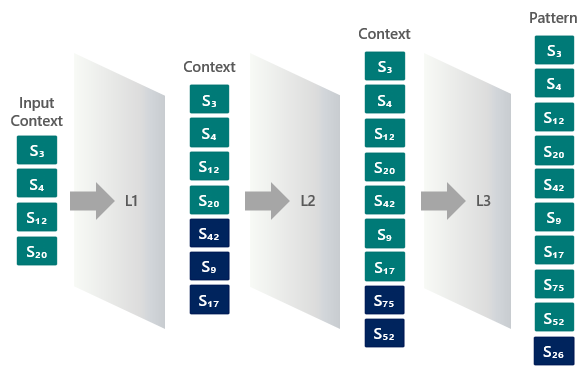
The mechanism of cross-layer memory transfer and cumulative reasoning represents the architectural counterpart of artificial intuition’s ability to “learn from prior experience and reinforce context”.
3.2. Data-Driven Prioritization
The search direction is guided not by random trials but by a data-driven prioritization mechanism. It ranks candidate solutions by informational value and contextual relevance, enabling the system to focus on priority regions instead of scanning the entire search space. By concentrating on structures with high pattern potential, the search process becomes goal-oriented from the outset.
This focused orientation reflects, at the technical level, artificial intuition’s ability to “quickly distinguish what is relevant”.
3.3. Adaptive Search Strategy
Instead of relying on fixed strategies, LMFO follows context-sensitive, data-driven, and adaptive paths when searching for patterns. The search direction dynamically shifts according to iteration progress and signal density. Weak signals and repeated attempts are tolerated initially, but once they exceed a threshold, they trigger a shift in direction.
This adaptation enables the system to abandon unproductive regions and refocus on more promising areas. In this way, LMFO not only identifies where to search but also intuitively determines where not to search.
This adaptive approach reflects the architectural counterpart of artificial intuition’s ability to “change strategy and reorient based on circumstances”.
4. Core Workflow of LMFO
The algorithm follows a cyclical structure: at each layer, the steps are repeated, and the final patterns extracted in the last layer undergo independent validation.
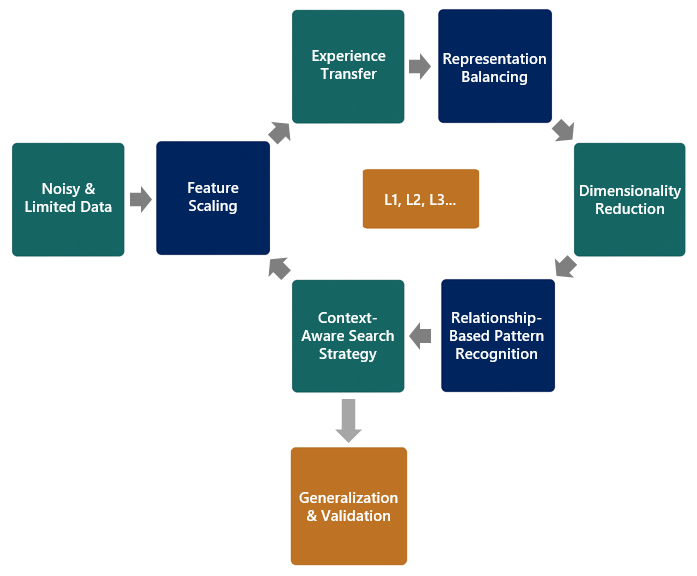
4.1. Data Preparation
Goal: Transform raw data into a consistent structure that LMFO can directly process.
- → Transformation: Raw data is converted into a binary (0/1) representation suitable for pattern mining.
- → Splitting: The dataset is divided into training, validation, and test subsets.
- → Transfer: The algorithm is trained exclusively on the training subset.
Value: This makes LMFO robust against noisy, imbalanced real-world datasets.
4.2. Feature Scaling in LMFO
Goal: Normalize features with varying noise levels to balance the search space.
- → Frequency and stability measurement: For each feature, a coefficient is calculated based on its mean and variance.
- → Signal prioritization: Based on the calculated coefficient, scaling emphasizes strong signals and weak-but-stable ones, while down-weighting weak and unstable signals.
Result: Noise is reduced, making critical signals more distinguishable.
Value: It ensures that both strong and subtle signals remain visible for enterprise-level decision support.
4.3. Experience Transfer
Goal: Carry knowledge gained from previous runs into new runs, guiding the search toward the right contexts.
- → Experience logging: Signal blocks extracted in earlier runs are provided to the algorithm as contextual cues.
- → Contextual propagation: The co-activation tendencies of these signals establish a global weighting mechanism across all features.
- → Continuity: Weighted features are reused in subsequent layers, ensuring that context is preserved throughout the process.
Result: The algorithm considers not only the signals in the current run but also the contexts revealed by past experience. The search space therefore becomes context-aware, enriched with knowledge accumulated across runs.
Value: LMFO retains memory across runs, becoming smarter with accumulated experience — unlike standard algorithms.
4.4. Representation Balancing
Goal: Prevent rare but meaningful signals from being lost during analysis.
- → Representation issue: Low-frequency but contextually critical signals are identified.
- → Balancing: Synthetic samples for these signals are generated using ROS/SMOTE techniques.
Result: Rare signals are preserved and the data distribution is balanced, increasing the efficiency of LMFO’s focused search strategies.
Value: This safeguards rare but critical signals, ensuring efficiency and scalability in complex datasets.
4.5. Two-Stage Coarse-to-Fine Reduction
Goal: Reduce the vast search space to a manageable size while preserving high-potential features.
- → Before representation balancing: Scaled features are ranked, and those with weak signal potential are eliminated.
- → After representation balancing: Features are re-ranked based on contextual fit, creating a targeted search space.
Result: Computational cost drops from astronomical complexity to a manageable scale.
Value: LMFO scales effectively without losing rare yet important features.
4.6. Relationship-Based Pattern Recognition in LMFO
Goal: Extract richer patterns by preserving context through cross-layer information transfer.
- → Relationship analysis: Signals are regrouped based on contextual alignment.
- → Diversity recovery: Features eliminated during dimensionality reduction but meaningful in context are reintroduced into the search space. This does not alter dimensionality; it updates diversity based on context.
- → Pattern enrichment: Contextually aligned signals are combined to produce more comprehensive patterns.
Result: Weak signals are preserved by gaining meaning within context.
Value: This enriches patterns while preserving context, giving LMFO an edge in complex, real-world problem solving.
4.7. Context-Aware Search Strategy
Goal: Continuously optimize the search process using feedback from data rather than fixed rules.
- → Parameter adaptation: The size and diversity of the search space dynamically change.
- → Direction shift: When progress slows, the strategy adapts and redirects toward more promising regions.
- → Context-aware strategy: The search space is continuously updated for each candidate pattern, guided by contextual feedback.
Result: LMFO performs more efficient searches by focusing on context-specific solution spaces.
Value: LMFO adapts dynamically, redirecting effort when progress slows — leading to faster convergence in uncertain environments.
4.8. Generalization and Statistical Validation
Goal: Objectively measure the accuracy and generalization of the extracted patterns.
- → Output transformation: Binary representations are converted into interpretable values.
- → Independent testing: Extracted patterns are evaluated separately on validation and test sets.
- → Stepwise evaluation: Performance is analyzed across different difficulty levels.
- → Statistical validation: Generalization, consistency, and statistical significance are systematically assessed.
Value: Independent validation confirms LMFO’s reliability and statistical significance in real-world scenarios.
5. Real-World Use Cases
LMFO is more than an accuracy-focused algorithm; it is a context-aware, intuition-driven decision support system that extracts patterns from statistically weak but contextually strong signals. Its modular, expandable layered architecture allows seamless adaptation to diverse data types and problem domains. Even with limited data and high uncertainty, its context-aware optimization consistently delivers reliable and generalizable results.
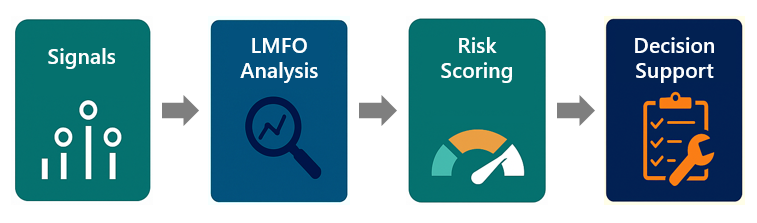
The mechanism is illustrated below through a scenario from industrial maintenance.
5.1. Predictive Maintenance with LMFO in Industrial Operations
5.1.1 Problem
In an automotive manufacturing plant, 100 different sensors continuously monitor critical machine parameters such as temperature, pressure, and humidity. During a failure event, an average of 25 sensors produce abnormal readings, but the triggered combinations differ each time, meaning there is no single “failure signature.”
5.1.2 Challenges
- → Scale issue: The number of possible sensor combinations is astronomical — ≈2×10²³.
- → Data issue: Data is limited to a few thousand failure records, covering only a tiny fraction of the solution space.
- → Noise issue: This limitation often leads traditional methods to dismiss rare but critical signals as noise.
5.1.3 LMFO’s Contribution
LMFO addresses these challenges with three core capabilities:
- → Indicator patterns: From limited failure records, LMFO extracts 10-sensor patterns that reliably indicate high breakdown risk.
- → Risk management: When 5–6 out of 10 indicators are triggered, it generates an early warning; at 7–8, a strong alert; and at 9–10, a critical alarm—reducing false positives and providing graded risk levels.
- → Prediction with limited data: It anticipates failure scenarios not yet observed in the dataset.
Together, these capabilities form key pillars of predictive maintenance: flagging failures in advance, grading risk levels, and projecting likely scenarios even with scarce data.
5.1.4 Business Value
Independent industry reports highlight the tangible benefits of predictive maintenance:
- → Operational reliability: Transitioning from preventive to predictive maintenance reduces unplanned downtime by 30–50% and extends equipment lifetime by 20–40% (McKinsey, 2017).
- → Cost savings: Maintenance costs decrease by 5–10%, operating expenses drop by ~12%, while uptime rises by 10–20% and asset lifespan extends by up to 20% (Deloitte, 2017; PwC & Mainnovation, 2018).
- → Financial impact: Large-scale manufacturing plants have reported annual savings in the tens of millions of euros (Siemens – Senseye Predictive Maintenance, case studies & ROI reports, 2021–2024).
5.2. Multi-Sector Adaptability
Thanks to its feature-agnostic, layered architecture, LMFO is not tied to a specific data type or industry. This enables direct application to a wide range of combinatorial problems across sectors. Only certain elements of the objective function may need to be redefined depending on the problem requirements—though in many cases, even this adjustment is unnecessary.
Sector-Specific Use Cases:
- Cybersecurity (SOC / Threat Detection)
→ 90 log types: In a typical attack, on average 25 become abnormal. LMFO extracts 8 critical log signatures.
→ Result: Threat levels are automatically graded based on partial matches. - Telecommunications Network Management
→ 85 KPI: In a network outage, ~20 show anomalies. LMFO identifies 9 critical KPI patterns.
→ Result: Proactive maintenance is initiated before failures escalate. - Finance / Banking (Fraud Analytics)
→ 80 risk indicators: On average 18 are triggered per event. LMFO extracts a 7-indicator fraud pattern.
→ Result: Transaction flows are scored in real time based on match levels. - Energy / Smart Grid Management
→ 75 parameters: In fault conditions, ~22 become critical. LMFO identifies 10 critical patterns.
→ Result: Regional failures are anticipated and mitigated in advance. - Railway Traffic & Signaling
→ 70 signals: In a traffic event, ~15 show anomalies. LMFO identifies a 9-signal pattern.
→ Result: Early warnings enable proactive adjustments to routes and speeds.
6. Benchmark Environment and Dataset
To evaluate the robustness and generalization capacity of LMFO in real-world conditions, the publicly available “On Numara” (“Number Ten”) dataset from Turkey was selected. This dataset provides a highly challenging benchmark due to its extremely low signal-to-noise ratio, limited number of observations, and vast combinatorial search space.
6.1. Problem
The system comprises 80 different items, with only 22 active in each event. The combinations of these active items vary from one event to another, meaning there is no single “critical signature”. This creates a high degree of uncertainty at scale.
6.2. Challenges
- → Scale issue: The number of potential item combinations is astronomically large — ≈2×10¹⁹.
- → Data issue: The available dataset is limited to 1.200 event records, meaning that over 99,99% of the search space remains unobserved.
- → Noise issue: Statistically weak but contextually meaningful signals can easily get lost under such high uncertainty.
6.3. Real-World Relevance
This structure aligns with scenarios where, under limited observations and low signal-to-noise conditions, critical event signatures must be identified through indicative patterns, even before all indicators fully emerge.
6.4. Indicative Pattern Solution
The indicative pattern approach involves extracting, for example, 10-element patterns from the 22 active items in each event. This method offers three key advantages that help the algorithm overcome the challenges outlined above.
- → Scalability: It reduces the massive search space, enabling the algorithm to operate within a manageable and focused solution domain (see items a, b, and c below).
- → Focused visibility: It transforms limited observational data into a meaningful solution space, largely mitigating the data constraint (see items d, e, and f below).
- → Signal preservation: It helps retain statistically weak but contextually meaningful signals within a scalable and focused structure.
6.5. Technical Explanation
- Raw search space: Choosing 22 active items out of 80: C(80;22) ≈ 2,7 × 10¹⁹.
- Scaled search space: Choosing 10 active items out of 80: C(80;10) ≈ 1,6 × 10¹².
- Scaling gain: The search space is reduced by roughly 16 million times: C(80;22)÷C(80;10) ≈ 1,6 × 10⁷.
- Solution space: Visibility in a single event, choosing 10 out of 22 active items: C(22;10) = 646.646.
- Scaled solution space: Visibility across 1.200 events: 646.646 × 1.200 ≈ 7,8 × 10⁸.
- Data gain: Observability increases by approximately 10 trillion times: (e/b)÷(1.200/a) ≈ 1,1 × 10¹³.
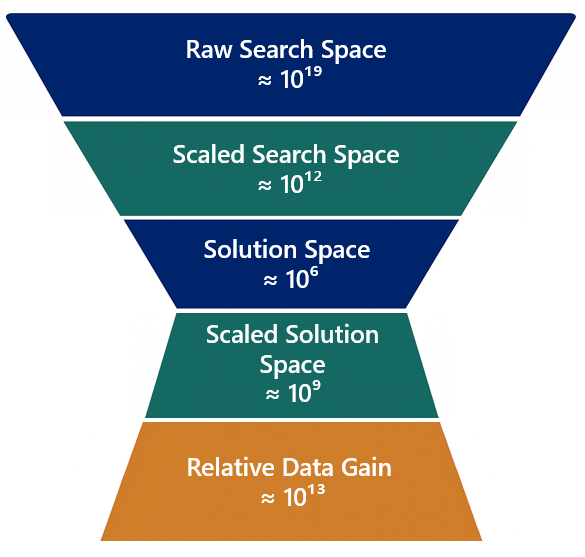
7. Performance Evaluation Method
Unlike machine learning models, LMFO does not rely on parameter optimization. Instead, it directly optimizes indicative patterns — signals that may appear meaningless individually but gain significance in context. Therefore, the algorithm’s success is measured not by individual signals but by the performance of the patterns they form.
Analysis Process Steps
- → Validation set: Data excluded from training provides the first performance signals.
- → Test set: Independent data is used to evaluate generalization.
- → Stepwise evaluation: Performance is measured across different signal intensities to assess consistency and robustness.
- → Comparative evaluation: Validation and test results are jointly assessed.
The steps and evaluation criteria used in performance measurement are summarized in the figure below.
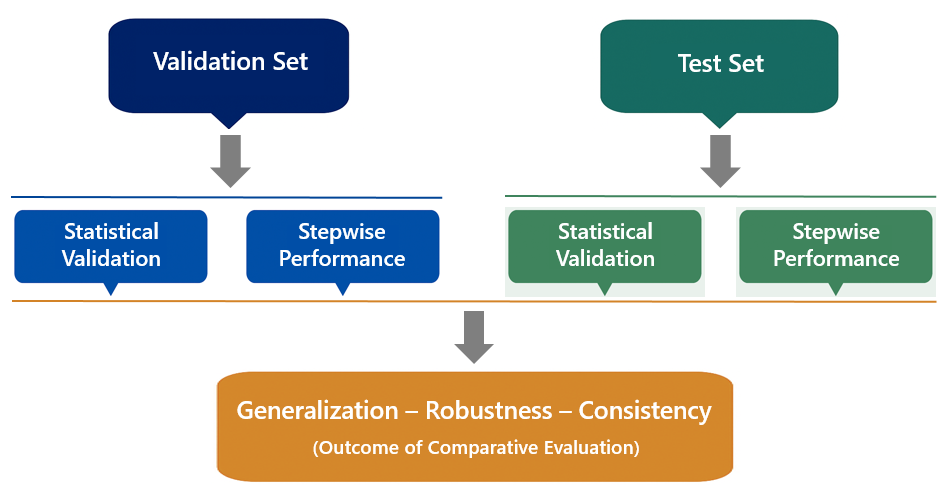
These steps objectively test LMFO’s ability to detect weak signals within context and demonstrate the algorithm’s capacity to deliver reliable and repeatable results on entirely new datasets across different levels of difficulty.
Performance Metrics
- → Pattern Recognition Score (PRS): Accuracy normalized by signal densities.
- → Expected Pattern Score (EPS): Evaluation of patterns on a standardized scale where the reference value equals 1.
- → Statistical significance: p < 0,05, one-tailed z-test.
Interpretation
- PRS > 1 → Patterns outperform expected scores.
- PRS < 1 → Patterns underperform expected scores.
Example:
- For the 8/10 category, PRS = 1,72 → Patterns are 72% more successful than expected.
- For the 9/10 category, PRS = 0,95 → Patterns are 5% less successful than expected.
This framework was developed to objectively measure LMFO’s context-aware inference capability in high-noise environments.
7.1. Technical Explanation
7.1.1. Pattern Recognition Score (PRS)
The actual performance of patterns was normalized for direct comparison across different signal densities. This adjustment amplifies the impact of rare signals (e.g., 9/10, 10/10) while down-weighting more frequent ones (e.g., 6/10, 7/10).
PRS = (Number of Actual Successful Patterns / Signal Density) / (Total Patterns × Number of Observations)
→ Result: Performance measurement becomes more balanced from a signal-to-noise perspective.
7.1.2. Expected Pattern Score (EPS)
For each category, expected performance of patterns is normalized using the same method to establish a reference metric.
EPS = (Number of Expected Successful Patterns / Signal Density) / (Total Patterns × Number of Observations)
In this formula, “Expected Successful Patterns” is defined as:
Expected Successful Patterns = Signal Density × Total Patterns × Number of Observations
Substituting this equality into the EPS expression always yields 1.
→ Result: The performance of extracted patterns can be measured on a standardized scale where the baseline equals 1.
Technical Note: In this study, 1.389 event records were used: 1.200 for training, 121 for validation, and 48 for testing.
8. Performance Analysis on High-Noise Real-World Datasets
LMFO can be initialized either from scratch or with small predefined starting solutions (e.g., 3- or 4-item seeds). These seeds trigger contextual analysis from the very first layer, improving both pattern quality and processing speed. In practice, the algorithm is provided with a large number of seeds. These are analyzed layer by layer, and only those that establish at least one meaningful context are transformed into indicative patterns.
4-item seed → L1 → 7-item patterns → L2 → 9-item patterns → L3 → 10-item indicative patterns
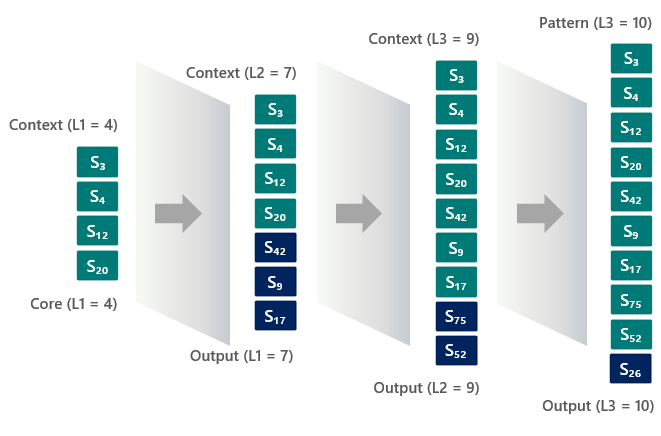
To thoroughly test the algorithm’s context-aware inference capability, two types of core solutions were used:
- → Optimized seeds: 4-item patterns previously extracted by the algorithm (214 in total).
- → Random seeds: Fully random 4-item sets (216 in total).
Both groups of seeds were provided as initial solutions.
Objective
- → To observe the algorithm’s pattern recognition performance under high-noise conditions.
- → To evaluate its capacity to transform weak signals into strong patterns when placed in context.
- → To test its ability to extract meaningful patterns from random seeds.
- → To assess the algorithm’s consistency under different initial conditions.
The table below shows that as pattern density increases, signal frequency decreases sharply, making the problem highly challenging. This explains why maintaining performance at higher match levels (e.g., 9/10, 10/10) is particularly difficult.
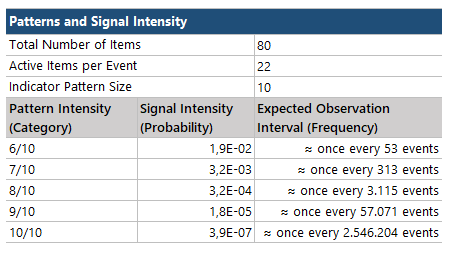
The real-world dataset used in this study clearly demonstrates the difficulty of pattern recognition under conditions of high noise and limited observations. This challenge provided a strong benchmark environment for testing LMFO’s intended context-aware pattern recognition performance.
Results were obtained under five predefined hyperparameter configurations. Both core groups were trained on the training data under these configurations and evaluated independently on validation and test sets. The results were then averaged to assess overall performance.
8.1. Pattern Recognition Performance on the Validation Set
The results in this section are based on evaluating patterns extracted from the training data — using both optimized and random seeds — on the validation set.
8.1.1. Validation Set — Optimized Seeds
The effects of LMFO’s layered and context-aware inference mechanism, as explained in the previous sections, are clearly reflected in the results obtained on the validation set.
In the table below:
- → Actual Value: The number of matches between the patterns extracted by LMFO and the active items in the validation set.
- → Expected Value: The average value expected under the same conditions according to probability theory.
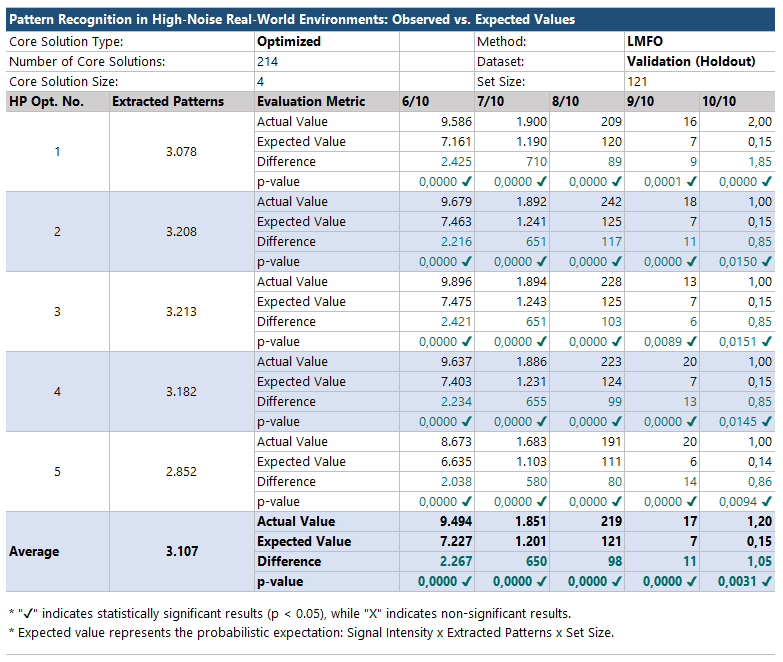
According to the table, LMFO produced results that exceeded the expected values across all signal densities (6/10–10/10) when using optimized seeds, with statistical significance (p < 0,05).

LMFO delivered results above the baseline (EPS) across all signal densities:
- High density (6/10–7/10) → PRS was 31–54% higher
- Medium density (8/10) → PRS was 81% higher
- Low density (9/10–10/10) → PRS was 2,64× and 8,12× higher (4,06×2)
Key Takeaways
The results obtained with optimized seeds demonstrate that LMFO’s contextual inference capability works effectively under high-noise conditions. While individual items (e.g., features) often do not carry a statistically significant signal when analyzed independently, the algorithm analyzes them in context and extracts meaningful patterns. In particular, patterns extracted under low signal density achieved scores up to 8× higher than the baseline (EPS = 1). This finding highlights LMFO’s mechanism of “reconstructing weak signals within context”.
Note: In the graph, signal density is shown on a logarithmic scale. In the 10/10 category, randomly generated reference solutions deviated from the baseline, but the difference was not statistically significant (p = 0.2556).
8.1.2. Validation Set — Random Seeds
The results on the validation set highlight the impact of LMFO’s data-driven prioritization and adaptive search strategies. Through these mechanisms, unproductive seeds were quickly eliminated, signal-bearing candidates were progressively reinforced across layers, and meaningful patterns were extracted from random seeds even under high-noise conditions.
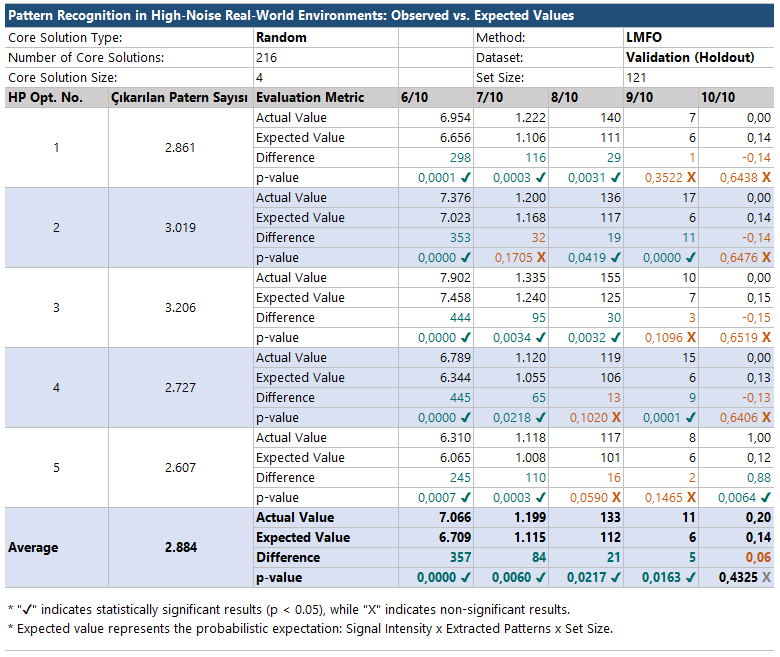
According to the table, LMFO delivered results that exceeded the expected values across all signal densities in the 6/10–9/10 range when using random seeds, with statistical significance (p < 0,05).
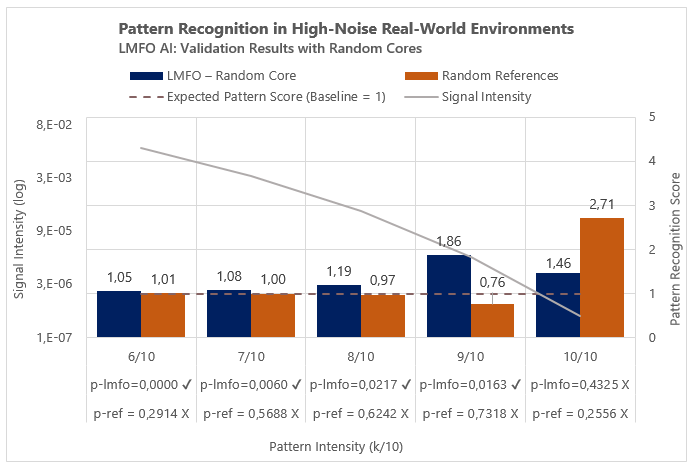
LMFO’s performance with random seeds:
- High signal density (6/10–7/10) → PRS was 5–8% higher
- Medium signal density (8/10) → PRS was 19% higher
- Low signal density (9/10) → PRS was 86% higher
Key Takeaways
Despite starting from random seeds, LMFO diverged significantly from the baseline in the 6/10–9/10 range. In particular, the strong performance at low signal density (86%) demonstrates the algorithm’s ability to “quickly identify relevant signals” and “adaptively reorient the search”. These results confirm LMFO’s robustness under high-noise and low-signal conditions.
Note: At the lowest signal density (10/10), the difference from the baseline was not statistically significant (p = 0,4325).
8.2. Generalization Performance on the Test Set
This section presents LMFO’s generalization performance on the test set, using both optimized and random seed solutions.
8.2.1. Test Set — Optimized Seeds
This section evaluates whether the results obtained with optimized seeds on the validation set were preserved when tested on independent data.

According to the table, LMFO delivered results that were above the expected values across all signal densities in the 6/10–9/10 range when using optimized seeds, with statistical significance (p < 0,05). This trend is consistent with the findings observed on the validation set, demonstrating stable performance across different datasets.
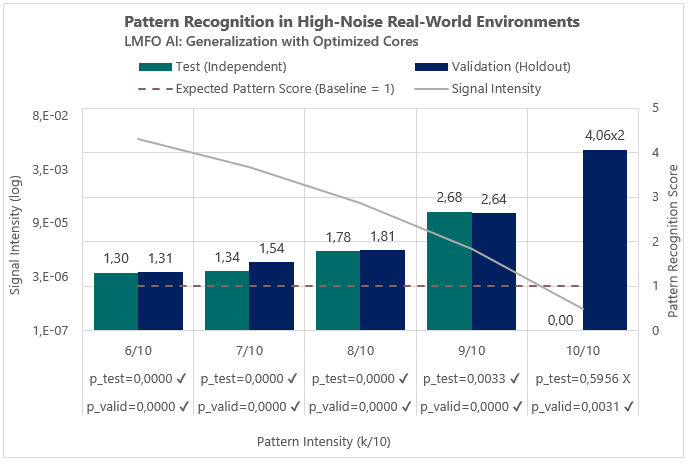
LMFO’s performance on the test set with optimized seeds:
- High signal density (6/10–7/10) → PRS was 30–34% higher
- Medium signal density (8/10) → PRS was 78% higher
- Low signal density (9/10) → PRS was 2,68× higher
Key Takeaways
The test set results show that LMFO’s intuitive inference capability is not limited to the training and validation phases. The trend observed in the validation set across all signal intensities from 6/10 to 9/10 was preserved on independent data. This consistency confirms the generalization of LMFO’s context-aware inference mechanism.
Note: At the weakest signal density (10/10), no statistically significant difference was observed (p = 0,5956), likely due to the limited size of the test set.
8.2.2. Test Set — Random Seeds
This section evaluates whether the performance observed with random seeds on the validation set was preserved on independent data.

According to the table, LMFO produced results that were above the expected values across all signal densities in the 6/10–9/10 range even with random seeds, with statistical significance (p < 0,05). At the weakest signal density (10/10), statistical significance was not achieved at the 95% confidence level (p = 0,0691), but was confirmed at the 90% level.

LMFO’s performance on the test set with random seeds:
- High signal density (6/10–7/10) → PRS was 5–18% higher
- Medium signal density (8/10) → PRS was 39% higher
- Low signal density (9/10) → PRS was 2,80× higher
- Weakest signal density (10/10) → PRS was 7,36× higher (3,68×2) — statistically significant at the 90% confidence level
Key Takeaways
LMFO preserved the significance of the patterns extracted during training from random seeds with no prior information, maintaining their validity not only in the validation set but also in the test set. The fact that this significance is retained across different datasets and seed (core) types demonstrates that LMFO can deliver reliable and generalizable results under challenging conditions.
8.3. Generalization, Robustness, and Consistency
The following table shows the pattern scores and significance levels obtained with both optimized and random seeds across the validation and test sets.

According to the table, optimized seeds achieved higher scores, while random seeds still yielded meaningful results under weaker contextual conditions. However, without optimized seeds, no significant score differences from the baseline value of 1 were observed, particularly at high and medium signal densities.

Pattern recognition performance of LMFO across different signal densities in the validation and test sets:
High and medium signal densities (6/10–8/10)
- Optimized seeds: Validation and test scores were nearly identical (1,30–1,81 range).
- Random seeds: Scores were lower (1,05–1,39), but generalization was preserved.
Low signal densities (9/10–10/10)
- Optimized seeds: Strong and consistent scores at 9/10 (2,64 → 2,68); at 10/10, validation was strong (8,12) but no significant result in the test set.
- Random seeds: Consistent and significant scores at 9/10 (1,86 → 2,80). At 10/10, validation was not significant (1,46), but the test set produced a score of 7,36, statistically significant at the 90% confidence level.
Key Takeaways
LMFO was able to extract meaningful patterns under high noise conditions using both optimized (strong) and random (weak) seeds. The consistency between validation and test sets demonstrates the algorithm’s ability to deliver reliable and generalizable results in challenging scenarios. Moreover, maintaining consistency across both different initialization conditions and varying signal densities strongly confirms LMFO’s robustness.
9. Conclusion
LMFO goes beyond anomaly detection by recognizing contextual patterns rather than single-signal outliers. It extracts patterns from statistically weak but contextually strong signals, providing reliable decision support under scarce data and high-noise conditions. This approach proves its value by consistently generating generalizable results, even in data environments with high uncertainty.
In real-world terms, this translates into solutions that flag failures in advance for industrial predictive maintenance, classify risky transactions in finance, identify critical log signatures in cybersecurity, and detect potential disruptions in telecom networks.
With its layered structure, adaptive search strategies, and context-aware inference capability, LMFO makes a difference especially in scarce data and low signal-to-noise conditions where traditional methods fall short. The findings from the validation and test sets demonstrate that LMFO does not yield temporary successes limited to a single scenario; instead, it delivers consistent, generalizable performance across different datasets, initial conditions, and difficulty levels. Therefore, LMFO stands out as a reliable artificial intelligence solution even under high-noise conditions.
In conclusion, LMFO is a practical, artificial intuition–based decision support system directly applicable to industrial scenarios. It is therefore one of the innovative algorithms capable of uncovering meaningful patterns in limited and high-noise data environments, delivering robustness and tangible business value.
The open-source implementation of LMFO is available on GitHub.